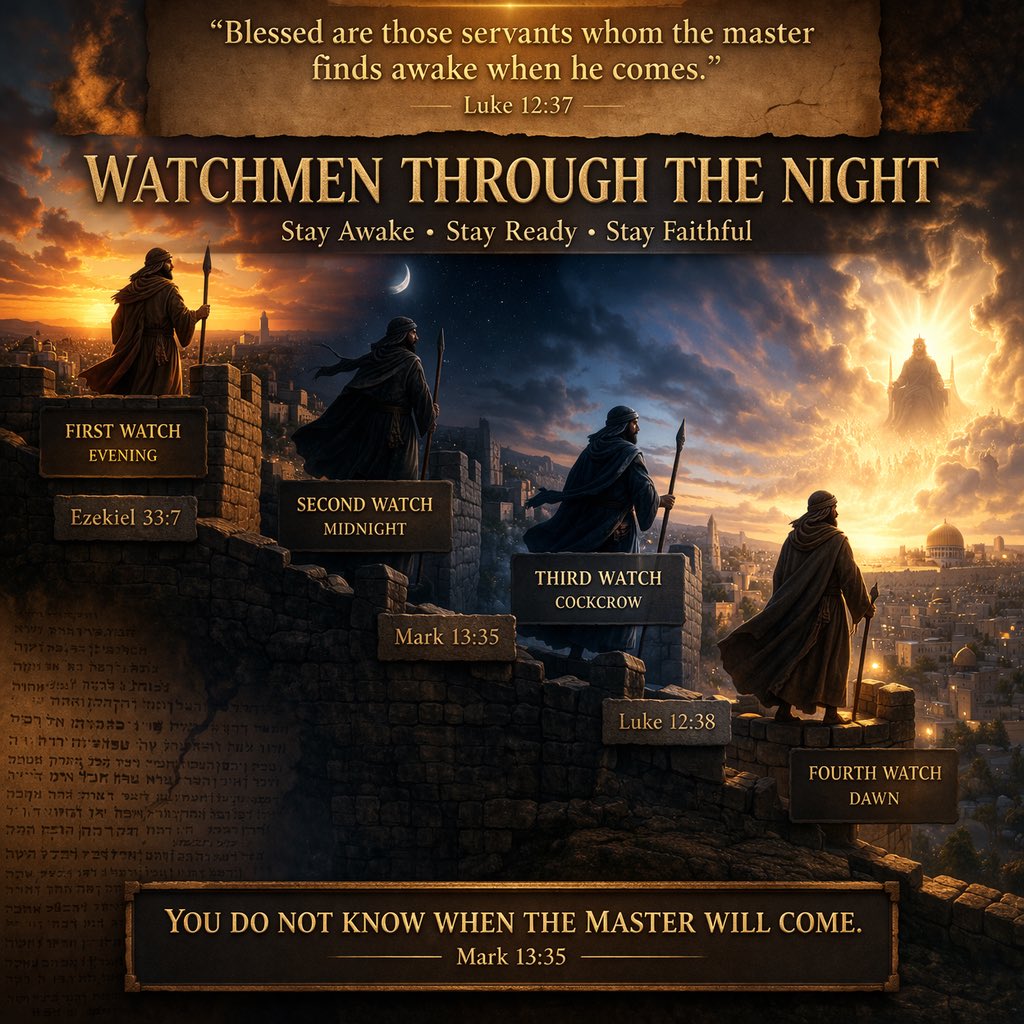
Hebrew tradition typically divided the night into three watches.
By the time of the New Testament, the influence of Roman culture had introduced a four-watch system, which was widely adopted in Jewish society. This Roman system divided the night into four watches, each lasting approximately three hours.
Hebrew (3 Watches): Traditional Old Testament structure, sometimes referenced as the first, middle, and morning watch (e.g., Judges 7:19), focusing on vigil periods.
First Watch (Sunset to ~10:00 PM): Called the “beginning of the watches” (Lamentations 2:19). It is a time for “pouring out your heart like water” and praying for the lives of children.
Second Watch (~10:00 PM to ~2:00 AM): Mentioned in Judges 7:19 when Gideon and his men launched their surprise attack on the Midianites.
Third Watch (~2:00 AM to Sunrise): Also called the “watch of the morning.” This is when the Lord looked down from the pillar of fire to trouble the Egyptians at the Red Sea (Exodus 14:24).
Roman (4 Watches): Adopted during the Roman occupation and used in the New Testament (e.g., Mark 13:35, Matthew 14:25). The 4 watches are Evening (6-9pm), Midnight (9-12am), Cockcrowing (12-3am), and Morning (3-6am).
The division of the night into watches had practical implications for the security of communities. Different guards were assigned to each watch to check against potential threats, whether from invading forces or other dangers.
This system ensured that there was always someone awake and alert, ready to respond to any situation that might arise.
Studying the watches is less about strict timekeeping and more about a posture of the heart. Jesus’ parables often emphasize that the Master may return during the “second or third watch.”