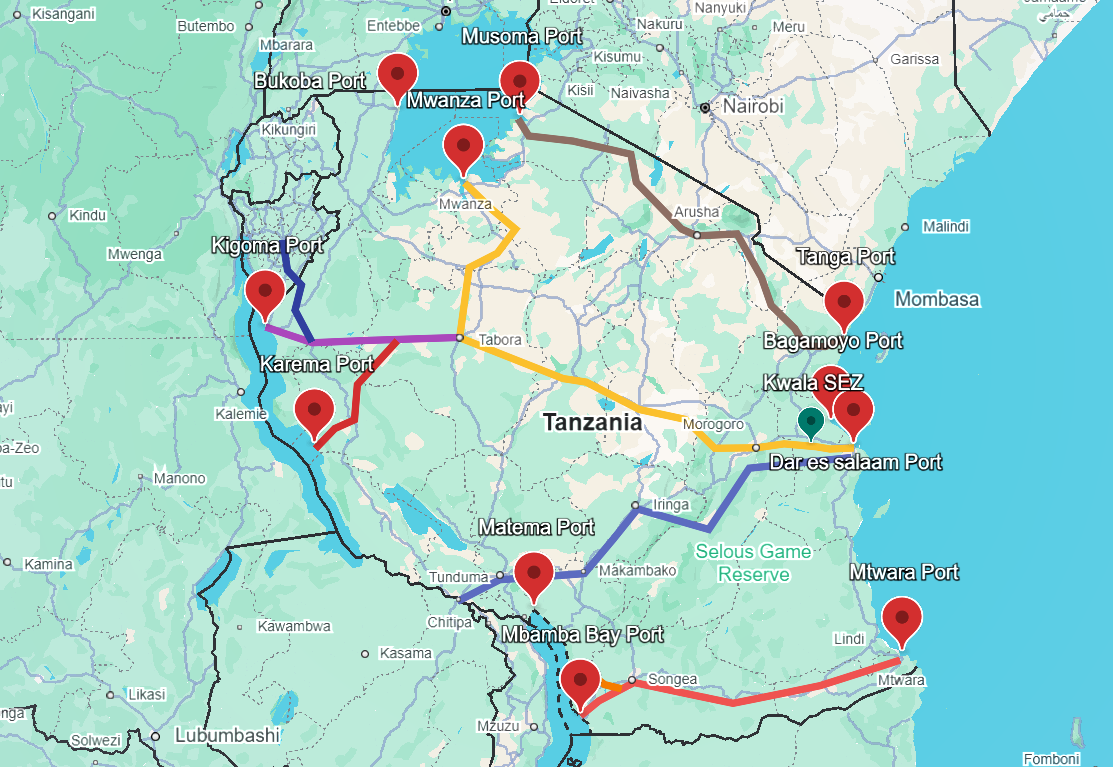
Tanzania is advancing its ambitious vision to become East and Central Africa’s premier logistics and trade hub. At the heart of this strategy is the massive integration of 11 key ports—on the Indian Ocean, Lake Victoria, Lake Tanganyika, and Lake Nyasa—with a modern, unified railway system comprising the new Standard Gauge Railway (SGR), the rehabilitated Meter Gauge Railway (MGR), and the historic TAZARA line.
This multi-billion dollar infrastructure investment aims to provide a fast, efficient, and cost-effective Central Corridor, directly linking its ocean gateways to landlocked nations and the Great Lakes region. The ports involved in this network span the entire country:
- Indian Ocean Ports: Dar es Salaam Port, Tanga Port, Mtwara Port, and the new Bagamoyo Port/Kwala SEZ.
- Lake Victoria Ports: Mwanza Port, Musoma Port, and Bukoba Port.
- Lake Tanganyika Ports: Kigoma Port and Karema Port.
- Lake Nyasa Ports: Mbamba Bay Port and Matema Port.
The Integrated Rail and Port Backbone
The integration effort is creating a seamless intermodal transport chain designed to slash transit times and logistics costs across the region.
 The Standard Gauge Railway (SGR)
The new SGR is the centerpiece of the network, connecting the principal port of Dar es Salaam to the country’s interior and, crucially, to the major Lake Victoria ports of Mwanza and Kigoma (Lake Tanganyika). The SGR segments are designed to eventually link up with Rwanda, Burundi, Uganda, and the Democratic Republic of the Congo (DRC), creating a modern, high-capacity artery for bulk and containerized cargo.
 The Meter Gauge Railway (MGR) and TAZARA
The existing MGR network is being rehabilitated and integrated, connecting key central points like Tabora to ports like Kigoma and Mwanza. Furthermore, the TAZARA (Tanzania-Zambia Railway Authority) line, connecting Dar es Salaam to Zambia’s copper belt, is undergoing a massive $1.4 billion overhaul. This revamp ensures a second, robust rail corridor to the south, strategically connecting Dar es Salaam Port and eventually linking up with the Southern ports like Mbamba Bay and Matema on Lake Nyasa, opening a route to Malawi.
This combined rail capacity will transform the handling of cargo, particularly from the Copperbelt and the Great Lakes, by offering a superior alternative to the traditional road-based logistics.