The ongoing strike by airport workers has brought business to a standstill in major airports in the country.
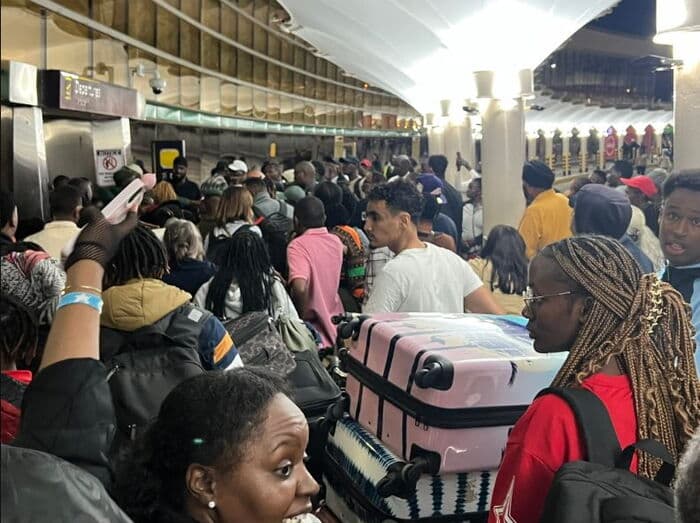
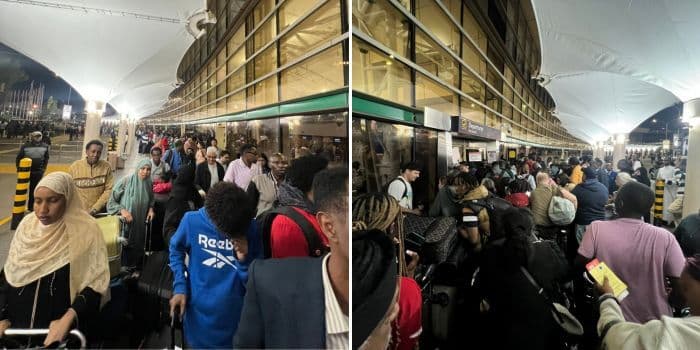
For the better part of Wednesday, the Jomo Kenyatta International Airport (JKIA) was characterized by long queues and passengers stranded as flights faced incessant delays while some were canceled altogether.
Nairobi Woman Representative Esther Passaris on Wednesday morning defended the controversial Adani takeover deal describing the much maligned agreement as a “potential game changer for airports in Kenya”.
Speaking at the Jomo Kenyatta International Airport (JKIA), Passaris claimed that Kenyans need to educate themselves more on the benefits the deal will present the country instead of reacting to prevailing sentiments, which has seen Kenyans across the country express their vehement opposition to the deal.
The Mzungu customer stranded at the Moi International Airport, 11 September 2024.
The strike which started at the JKIA inspired aviation sector workers operating at Moi International Airport, Kisumu International Airport, and Eldoret International Airport to join in demanding accountability on the nature of the JKIA upgrade deal signed between the government and Indian conglomerate Adani.
“Kenyans need to understand what the Adani group will provide. I have been to Ahmedabad Airport (India) that was done by Adani. The first time I went to Ahmedabad airport, four years ago, it was a mediocre airport, today it’s one of the five-star airports,” Passaris stated as she was leaving the country for Johannesburg where she is expected to represent Kenya at a Pan African Parliament forum.
Passaris went ahead to praise the value of infrastructure Adani constructed around the Ahmedabad airport. She opined that the only negative surrounding the deal is the Kenya Kwanza government’s reluctance to come clear on the terms of the deal and educate Kenyans on its benefits.
“When you try and have a big contract, there are many people who want that contract. The government should come clear and that’s why we have a government spokesperson, to break it down and help people understand how much money are they gonna put into the airport,” she stated.
As the airport workers continued to stage their strike, Kenyans and passengers streamed into the country who bore the brunt.
Long queues witnessed at JKIA as KAA workers down tools. Photo Edwin Dande
Persons inconvenienced by the strike spent the better part of the day expressing their disappointment and frustrations.
One highlight from the day was the plight of a white man who vented his frustrations expressing fears that his marriage was at risk. The man claimed that due to the delay in flights, his wife might probably divorce him by the time he gets home.
“Now we are here to suffer, my flight is delayed, I will miss my wife and she will probably divorce me when I reach Kisumu as a result of their actions”, the man lamented.
" I am disappointed, we have been here for over three hours and have not gotten any communication, we have important things to do," another customer complained.
“It’s been chaotic… there were hundreds of people outside the airport when we arrived but we stood around and eventually made it inside," a female passenger who cut short her holiday trip to Kenya to go back to the Netherlands for a funeral told journalists.
Among those stranded was also Zimbabwe men’s football team. The team had flown into Nairobi after an African Cup of Nations qualifier game in Uganda.
Defending their move, the airport workers have revealed that the protests are necessary as they are pushing to be heard.
“We are pushing to keep our jobs, we are pushing to avoid being colonized again”, KAA workers at the Moi International Airport said.
“We have never seen those Adani documents they are talking about, it would have been better if Adani himself came here and explained what is happening to us.” Another worker said.
The Kenya Aviation Workers’ Union previously warned of an indefinite strike after the government failed to disclose details of the Adani deal.
City lawyer Francis Njoroge Wanjiku has issued a demand to the Kenya Electricity Transmission Company Limited (KETRACO) over the controversial Adani deal as protests at major airports in the country persist.
In the letter obtained by Kenyans.co.ke, the lawyer has asked KETRACO to make public the particulars of any Private-Public Partnership (PPP) deal with the Adani Group.
“We wish to exercise our right to access to information held within your organization including but not limited to project agreements, financial capacity of the tendering company, the tendering process undertaken, public participation and approval of the Attorney General.”
Speaking exclusively to Kenyans.co.ke, Njoroge said the demands were prompted by the coy nature of the government in revealing the particulars of the partnership with Adani.
“Apart from the Cabinet’s approval, there was no public participation. There is no telling what the deal is about and that is why we want to move to court,” he said.
His statement comes amid a wave of protests at the Jomo Kenyatta International Airport on Wednesday, September 11, as aviation workers downed their tools.
For the better part of Wednesday morning, operations were paralysed at JKIA and other airports across the country as aviation industry workers continued to stage strikes, leading to cancellation of flights.
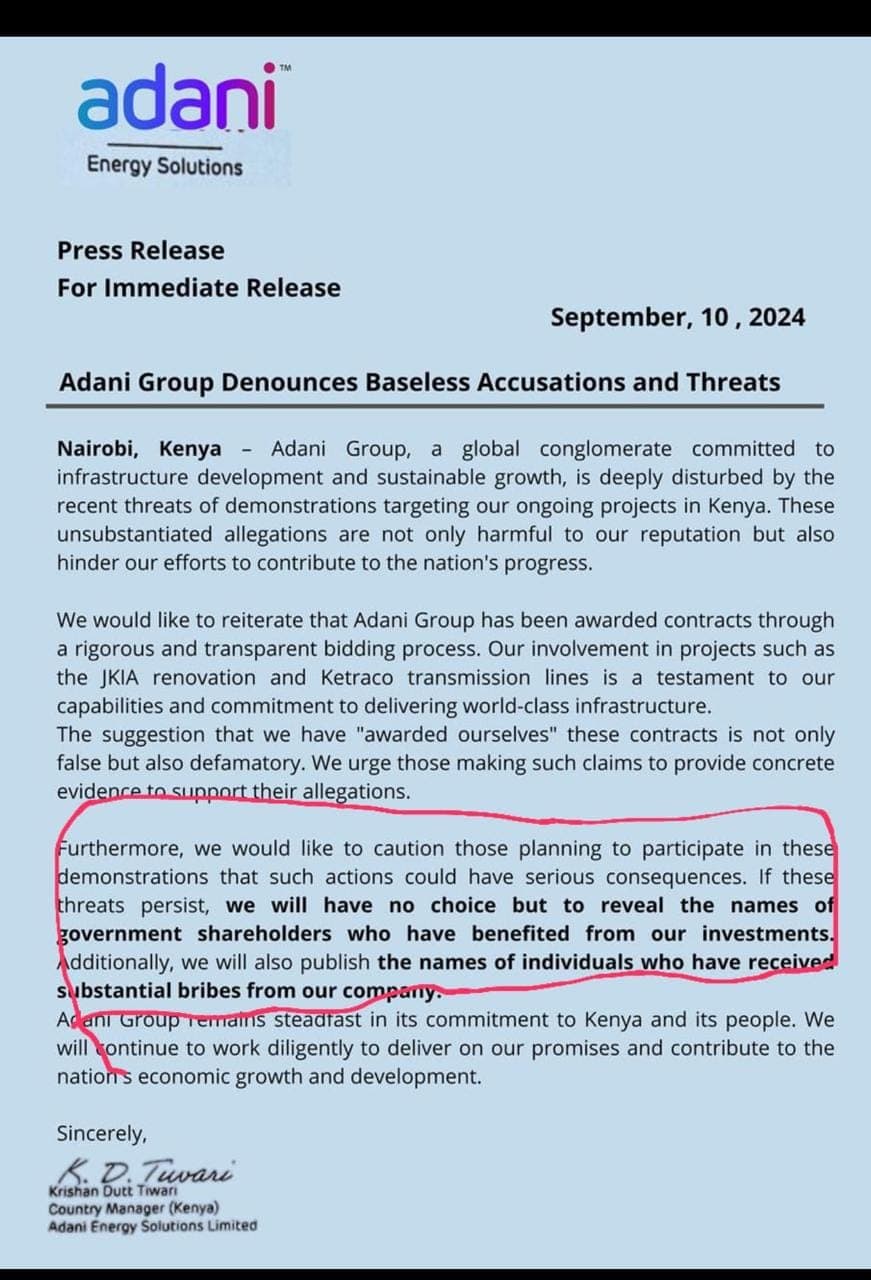
Despite Adani Group’s controversial global track record, its subsidiary Adani Energy Solutions Limited (AESL) secured approval for a multimillion-dollar energy transmission project in Kenya.
This move, which was under the Private-Public Partnership (PPP) framework, instantly sparked fear that the government could be opening doors to more than just foreign investment.
Kenya Aviation Workers Union (KAWU)'s Secretary General Moss Ndiema recently revealed part of the reason aviation workers went on strike was because of the government’s apparent ingenuity over the Adani deal.
“The government has not been straightforward and they are not genuine. They have not provided us with all the documents that we demanded. All we want is the government stop the Adani deal,” he stated in an interview with a local publication.
Meanwhile, the Kenya Kwanza government has largely attributed the move to partner with the Indian conglomerate to budgetary constraints.
After the fall of the controversial Finance Bill brought about by nationwide ‘Gen Z protests’, President Ruto has seemingly shifted focus to the private sector to drive his development agenda.
The Law Society of Kenya (LSK) and Kenya Human Rights Commission (KHRC) have since successfully moved to court to block the controversial takeover.

 Is Running Short Of Fools! System Ya Majambazi! #RutoMustGo #AdaniMustGo