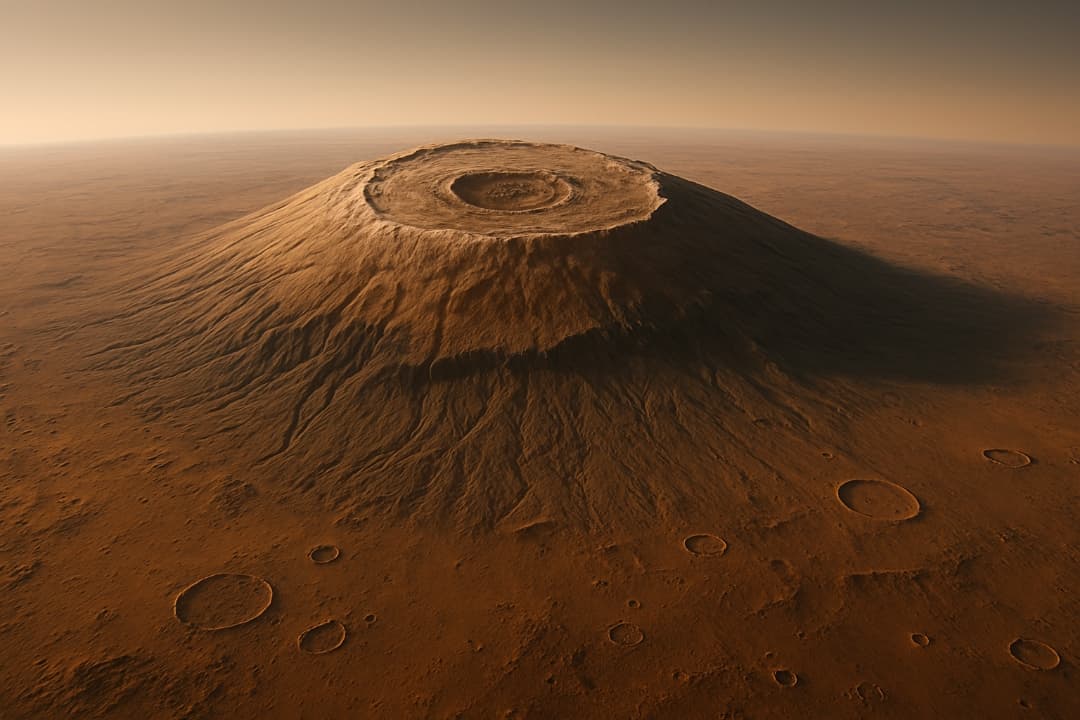
Olympus Mons is the tallest volcano in the solar system—rising about 13.6 miles (22 km) high and spanning 370 miles (600 km) wide, it dwarfs Mount Everest and covers an area roughly the size of Arizona or France. Its gentle slopes, massive caldera, and potential for recent activity make it one of Mars’s most fascinating geological features.
Key Facts About Olympus Mons
Size and Scale
- Height: ~13.6 miles (22 km) above Martian datum—nearly 3× taller than Mount Everest.
- Diameter: ~370 miles (600 km)—comparable to the size of France or Arizona.
- Caldera: ~50 miles (80 km) across, formed by collapsed magma chambers.
- Slope: Extremely gentle (~5°), typical of shield volcanoes formed by fluid lava.
Geological Features
- Type: Shield volcano, similar to those in Hawaii but vastly larger.
- Formation: Built up over millions of years by repeated lava flows.
- Escarpment: Steep cliffs up to 6 km high surround the base, possibly formed by gravitational collapse.
- Aureole deposits: Lobed terrain around the base, possibly from landslides or lava spreading under low gravity.
Activity and Age
- Geological Youth: Olympus Mons is considered geologically young, with lava flows possibly as recent as 2 million years ago.
- Potential Activity: Some scientists believe it may still be dormant rather than extinct, due to lack of plate tectonics on Mars.
- Discovery: First identified by Mariner 9 in 1971, later imaged in detail by Viking and Mars Global Surveyor missions.
Scientific and Exploratory Significance
- Ideal for Study: Offers insights into Martian geology, volcanic processes, and planetary evolution.
- Landing Challenges: The thin atmosphere and high elevation make landings difficult—air pressure is too low for parachutes to work effectively.
- Terraforming Interest: Some speculative proposals suggest using volcanic heat or lava tubes for future Martian habitats.|