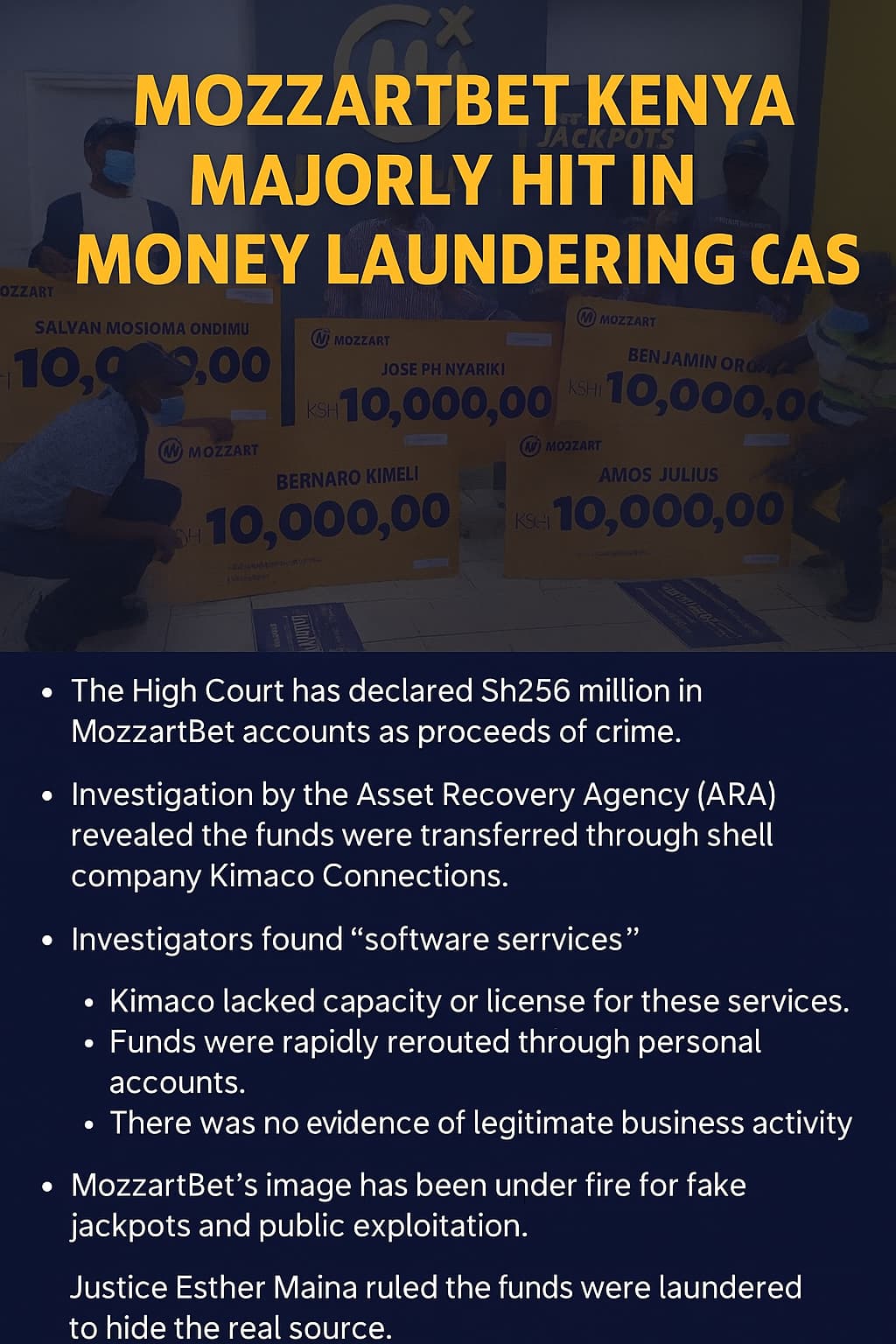
MozzartBet Kenya has been thrust into the spotlight once again, this time over financial crime allegations that have resulted in the forfeiture of a massive Ksh 256 million. The High Court, in a damning verdict, declared that the money held in the betting company’s accounts was the product of criminal activity and ordered it to be surrendered to the State.
The ruling, delivered by Justice Esther Maina, followed a lengthy investigation by the Asset Recovery Agency (ARA). The agency linked the funds to a shadowy business transaction involving a company known as Kimaco Connections, which was allegedly used as a shell company to launder illicit money under the guise of providing software services.
Investigations revealed a deeply troubling money trail that exposed MozzartBet’s role in what the court described as a deliberate scheme to mask the source and purpose of funds. According to court documents, MozzartBet transferred Ksh 256 million to Kimaco Connections over a period of just 11 days, raising immediate red flags. There were no valid contracts, no proof of software or services delivered, and no documentation to justify such a massive outflow of funds.
The money was then quickly dispersed through personal bank accounts in what authorities called a textbook case of money laundering. ARA’s report showed that:
- Kimaco lacked any licensing or operational history in software services.
- There was no invoicing, no email correspondence, or documentation to support the transactions.
- Funds moved through multiple unregistered or unrelated individual accounts in small tranches.
The court emphasized that the structure of these transfers was designed to create distance from MozzartBet’s original account—an effort to make the funds “clean” through layering and integration, which are classic hallmarks of a money laundering process.
MozzartBet’s defense team tried to paint the payments as a business transaction that fell within normal operations. They claimed the funds were used to acquire technology services, but the judge dismissed the explanation as vague, unsubstantiated, and deceptive. She noted that the evidence showed an intentional plan to siphon money from the betting firm through fraudulent means and that MozzartBet failed to demonstrate any due diligence or transparency.
This ruling further dents the public image of MozzartBet Kenya, which has in recent years battled other serious accusations—including claims of misleading the public with fake jackpot winners, exploiting desperate youth, and engaging in irresponsible advertising.
The Betting Control and Licensing Board (BCLB), which regulates gaming in Kenya, is now under growing pressure to audit MozzartBet’s operations, probe its directors, and possibly revoke its license. Civil society groups and online users have taken to social media demanding accountability, asking why such a company is still allowed to operate within Kenyan borders even after such damning findings.
Legal experts say this may be only the beginning of a larger crackdown on betting firms operating in Kenya without sufficient financial oversight. Many are already questioning whether MozzartBet is the only one using such methods or if this is part of a much broader pattern across the betting industry.
What makes the case even more concerning is the lack of response from MozzartBet itself. As of today, the company has not issued any official statement regarding the High Court’s ruling. This silence has only fueled more suspicion among the public, with many interpreting it as an admission of guilt or an attempt to avoid public scrutiny.
The court’s decision sets a powerful precedent for dealing with financial misconduct in Kenya’s high-stakes gambling industry. It also sends a message that even major players with large market shares are not immune to accountability when it comes to financial regulations and anti-money laundering laws.
As more Kenyans turn to betting—often out of economic desperation—questions continue to swirl around whether companies like MozzartBet are truly offering legitimate services or just preying on the vulnerable while running shady operations behind the scenes.
With Ksh 256 million now officially declared as criminal proceeds, the spotlight is firmly on MozzartBet. What happens next could reshape how Kenya deals with financial crime in the digital gambling sector.