One alarming incident of racism has come to light. A white man, stopped a black amazon driver who was simply trying to complete his delivery. He asked the driver what was he doing in a private property as the driver tried to say he was simply doing his job.
Two videos have gone viral on this regard. Atlanta Black Star reports, user @kavonbooker posted the clips on TikTok in July; they have received more than ten million views. In the first clip, the heated exchange between the white resident and the black driver is captured. When pressed about what he was doing there, the man said, “I have an Amazon shirt on.” Still this explanation was not enough for the White man as he fired back again. He said, “That doesn’t mean you can come on private property anytime you want to.”
https://twitter.com/i/status/1950176273512165447
The Amazon driver wasn’t going to sit silent either. And why should he be? He was verbally attacked for all the wrong reasons while simply trying to finish his job. He responded saying, “I’m just here delivering packages. I won’t be here ever again.” The resident replied with a “Good.” The driver asks him to call police to which the resident agrees. He even says he will have him (the driver) ‘trespassed.’
At one point, he even boasts one of the residents in the area is his boss, who happens to be a retired cop. Then he calls him up to accuse the driver of trespassing.
In the other video, both the men are seen talking to another Amazon driver, who happens to be white. He was there to deliver packages as well. The white resident dismissed the trespassing accusations towards the black driver earlier. Rather, he explained to the white driver he approached his vehicle to ask about his deliveries.
The black driver stands his point. “That’s none of your business what I got to deliver,” he says. The white driver says to his colleague, “You have a job to do.” The black driver responds with, “Yeah I am, but this man came over here harassing me!” The white resident tried to stand his ground and said he was just asking about his deliveries to which the black driver told him he was clearly interfering with his job.
The resident yelled, “Just shut your f—–g mouth!” The driver yelled back, “You shut your f—–g mouth!” Eventually, the black driver walks back to his truck to drive off. He gets into his Hertz truck. The white driver, on the other hand, had the official truck with the concerned logo.
https://x.com/Toure/status/1388920181599178755?ref_src=twsrc^tfw|twcamp^tweetembed|twterm^1388920181599178755|twgr^d2c4f6b6f8eced4802903c59561a99e429957096|twcon^s1_&ref_url=https%3A%2F%2Fwww.inquisitr.com%2Fshut-your-mouth-white-man-blocks-black-driver-cries-trespassing-but-his-white-colleague-gets-a-pass
Since the launch of Amazon Flex services in 2015, the company allows independent contractors to handle deliveries in their own vehicles. The official uniform isn’t a must for the contractors but the company encourages them to be in safety vests. Some even get the Amazon ones to use in their jobs. Another video went viral last year, where it could be seen a gated community blocking a Flex driver. They weren’t sure if she was there to make deliveries. She was wearing the official Amazon vest.
Some customers have criticized the lack of standard uniform policy because it becomes difficult to identify Flex drivers without the official dress.
Alex O’Keefe, the award-winning screenwriter behind FX’s The Bear, said he was removed from a Metro-North train and arrested after a white woman complained about the way he was sitting.
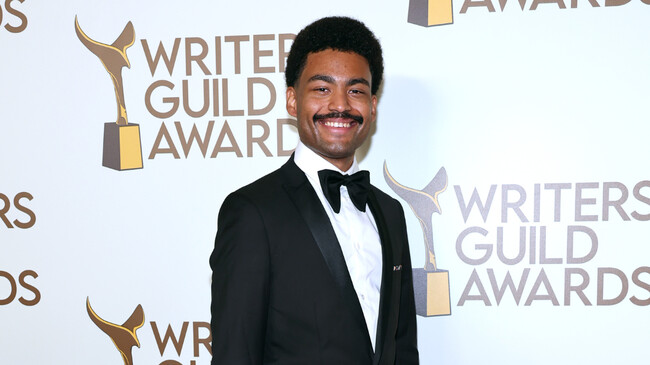
On Sunday (September 21), O’Keefe took to Instagram to detail the incident, sharing footage from his encounter with police who responded to the white woman’s complaint.
“I was arrested on the @MTA train to Connecticut today, pulled off, handcuffed, and detained,” O’Keefe wrote. “You’re gonna arrest the one Black dude on the train, because this white woman said she didn’t like the way I was sitting.”
One video shows O’Keefe filming police officers and the elderly white woman who made the complaint.
“You call the police to arrest the one Black dude on the train,” he said in the video. “I haven’t done anything illegal.”
After boarding the train, O’Keefe said the woman immediately told him to correct how he was sitting, to which he refused. The woman then complained to the conductor, who stopped the train and called the police.
“The police told me to leave the train, I refused and asked what was I doing illegally,” O’Keefe wrote. “They said I was disturbing the peace by not leaving the train. They pulled me off the train and arrested me without even talking to the Karen who reported the one black person on the train.”
The screenwriter said he was detained and interrogated on the platform.
“Only Black folks stayed nearby and recorded the arrest,” O’Keefe said. “When I demanded a lawyer and reminded them they didn’t even take a statement from the woman who complained, they eventually released me.”
O’Keefe also claimed the woman’s friend told him, “You’re not the minority anymore.”
White man explodes at wife for smiling at a Black person; customers and staff band together to defend her
The once-viral Reddit video featuring Black customers and staff banding together to protect a white woman from her abusive husband has resurfaced. In light of growing cases of racism, netizens have begun re-sharing the Mississippi restaurant incident to raise awareness about the matter on social media.
https://twitter.com/i/status/2010099949871214676
Shocked by the outburst, the child began weeping and clung to her mother. The man continued yelling while a bystander was recording the video.
At one point in the video, he was seen throwing a pack of cigarettes at his wife, threatening to “clear out” the Mississippi restaurant. During this entire time, the woman watched in horror and fear as her abusive husband continued shouting at her in front of their daughter. This was only part one of the video, and several comments empathized with the woman and her daughter. Users also pointed out the racism.
One user wrote, “OMG free her.” Another mentioned, “She’s scared, man…I’m sad.” A third user pointed out, “Wow. I mean, if he can abuse her like that in public, imagine what goes on in private.” A fourth one said, “How terrifying for her and her child.”
Many concerned netizens urged the woman to “leave” her abusive husband. Her brother, David, recently identified himself in the comment section of the post. David revealed that his sister and her daughter were safe from the soon-to-be ex-husband.
Another reason why users online were urging the woman to leave her abusive husband was what happened in the second video posted by the same page. In the video, the couple appeared to have paid the bill while the husband was yelling. He then yelled, “Lets go!” And proceeded to pick up the child in anger.
After fiery banter and a pole broken by a Black man in an attempt to drive the man away, the couple finally left with their young daughter still crying. Specific details about the whereabouts of the woman remain unknown at this time. However, per the brother’s confirmation, she is reportedly safe.
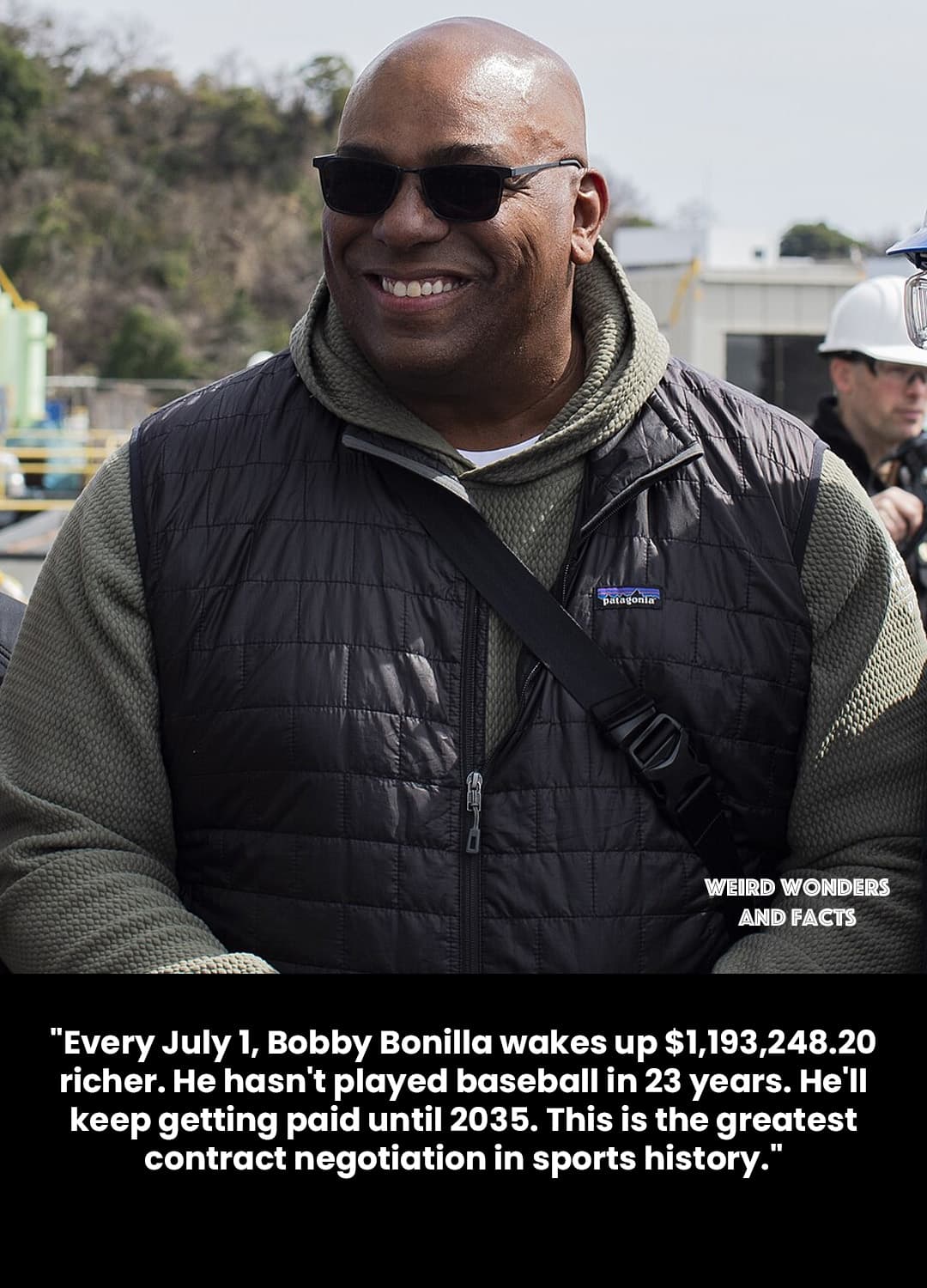
Every July 1, Bobby Bonilla wakes up $1,193,248.20 richer. He hasn’t played baseball in 23 years. He’ll keep getting paid until 2035. This is the greatest contract negotiation in sports history.
Like clockwork, the New York Mets send Bobby Bonilla a check for $1,193,248.20.
Not for playing baseball. Not for coaching. Not for showing up at the stadium.
Just for existing.
They’ve done it every July 1 since 2011. They’ll keep doing it every year until 2035—when Bonilla turns 72 years old.
How did a retired player land the most famous contract in sports history?
THE DEAL
Year 2000. Bobby Bonilla’s time with the New York Mets was ending badly. He wasn’t producing. The relationship had soured. Both sides wanted out.
The problem? The Mets still owed Bonilla $5.9 million on his contract.
Most players would take the money and walk away. Get paid, move on, end of story.
But Bonilla’s agent, Dennis Gilbert, saw something different.
Gilbert wasn’t just a sports agent. He was an insurance expert who deeply understood annuities and deferred compensation. He looked at that $5.9 million and saw opportunity.
He proposed a deal that seemed crazy:
Instead of paying Bonilla the $5.9 million immediately, defer it for 11 years. Add 8% annual interest. Then pay it out in 25 equal installments starting in 2011.
The math was simple but stunning:
$5.9 million today → $29.8 million over 25 years.
Most teams would laugh at that proposal. Why would anyone volunteer to turn $5.9 million into nearly $30 million?
The Mets agreed. Eagerly.
THE REASON
Mets owner Fred Wilpon thought he was being brilliant.
He was invested with a money manager who promised consistent double-digit returns every year. If those investments performed as expected, the Mets would earn more than the 8% they were paying Bonilla.
They’d pocket the difference and come out ahead.
Financial arbitrage. Smart business. Calculated risk.
That money manager was Bernie Madoff.
THE TWIST
For years, everything seemed fine. The deal was working. The Mets were invested with Madoff, earning returns, and the Bonilla payments wouldn’t start until 2011 anyway.
Then 2008 happened.
Bernie Madoff’s $65 billion Ponzi scheme—the largest financial fraud in history—collapsed. Investors lost everything. The Wilpon family, heavily invested with Madoff, faced massive losses.
Suddenly, the Mets’ brilliant financial arbitrage became baseball’s most infamous blunder.
What looked like savvy accounting became a punchline that would last decades.
Meanwhile, Bobby Bonilla kept preparing to cash checks.
THE GENIUS
Here’s what people miss about the Bobby Bonilla deal:
He didn’t predict Bernie Madoff’s fraud. He didn’t know the Mets would make a catastrophic investment mistake.
He simply negotiated guaranteed income.
No stock market crashes could touch it. No bad investments could affect it. No economic downturns could reduce it.
Just $1,193,248.20, arriving like clockwork, every July 1, for 25 years straight.
While the 2008 financial crisis destroyed retirement accounts, investment portfolios, and fortunes across America, Bonilla’s deal remained untouchable.
Guaranteed. Locked in. Certain.
And here’s the kicker: Bonilla has a SECOND deferred deal.
The Baltimore Orioles have paid him $500,000 every year since 2004—and will continue through 2028.
Bonilla played for Baltimore for just two seasons in the mid-1990s.
Two teams. Two deferred contracts. Decades of guaranteed payments.
THE LEGACY
Today, July 1 is known as “Bobby Bonilla Day.”
Mets fans treat it like a bitter holiday. Social media explodes with jokes. Sports websites publish annual reminders. It’s become part of baseball culture.
Current Mets owner Steve Cohen has even suggested celebrating it at the stadium with an oversized novelty check—leaning into the absurdity rather than running from it.
But beyond the jokes and the memes, there’s a real lesson buried in this story.
Bobby Bonilla didn’t outsmart Wall Street with superior financial knowledge. He didn’t predict economic crashes or investment frauds.
He hired someone who understood finance better than he did—and trusted that person to negotiate on his behalf.
The power of the deal wasn’t delayed gratification or complicated investment strategies.
It was guaranteed income.
In a world where markets crash every decade, where “sure thing” investments fail, where fortunes disappear overnight—Bonilla locked in absolute certainty.
That $1,193,248.20 arrives every single year no matter what happens to:
The economy
The stock market
The Mets’ finances
Baseball itself
It doesn’t matter if the Mets are winning or losing. Doesn’t matter if they’re profitable or struggling. Doesn’t matter what the inflation rate is or whether there’s a recession.
The check arrives. Guaranteed.
THE LESSON
Most people chase the highest possible returns. The biggest gains. The most aggressive growth.
Bobby Bonilla chose certainty instead.
He took $5.9 million and turned it into $29.8 million simply by negotiating a contract that couldn’t fail him.
No genius required. No market timing. No risky bets.
Just a well-structured deal that paid him consistently for 25 years.
Sometimes the smartest financial move isn’t chasing the moon. It’s knowing exactly what you’ll have—and when you’ll have it.
While the Mets thought they were playing 4D chess with Madoff’s investments, Bonilla was playing a simpler game:
Get paid. Guaranteed. Forever.
THE REALITY
Every July 1, Bobby Bonilla receives $1,193,248.20.
He’s 60 years old now. Hasn’t played baseball since 2001.
He’ll receive that payment every year until he’s 72 years old.
Total: $29,831,205 for $5.9 million deferred.
The Mets still have 11 more years of payments ahead.
The joke writes itself. But so does the lesson.
Bobby Bonilla might be baseball’s greatest punchline—but he’s also proof that sometimes the best financial strategy is the boring one.
Guaranteed income. No risk. Absolute certainty.
While others chase returns, Bonilla just cashes checks.
Happy Bobby Bonilla Day. 
White shopper frustrated over long checkout line rams cart into Black woman, but backs off after Black man steps in
The altercation took place on Jan. 22, and a woman who goes by momlife2020tx online captured the aftermath on video, including an unidentified Black man who stepped in to help and likely prevented the woman from suffering further abuse, verbal or otherwise.
![An older white man was charged with misdemeanor assault on a Black female shopper in a Dallas-area Walmart after ramming his shopping cart into her. […]](https://img-s-msn-com.akamaized.net/tenant/amp/entityid/AA1Vacxh.img?w=768&h=432&m=6&x=235&y=152&s=51&d=51 "An older white man was charged with misdemeanor assault on a Black female shopper in a Dallas-area Walmart after ramming his shopping cart into her. […]")
An older white man was charged with misdemeanor assault on a Black female shopper in a Dallas-area Walmart after ramming his shopping cart into her. […]
According to momlife2022tx, customers were on edge that day, preparing for the treacherous winter storm and Arctic cold front that blasted North Texas over the weekend.
https://twitter.com/i/status/2014504567732404521
“It was packed… so the line was literally wrapped around to the back of the store,” she said in a follow-up video on TikTok. “A minute later, we look up, and this man is in front of us. First of all, how did he get there? Second of all, he’s ramming [the woman] with his cart, and I said, ‘Hey, don’t hit her with your cart.’ That’s when I started videotaping.”
The video begins moments after the shopping cart assault, during a tense standoff between the Black woman and the older white man. She warned him not to hurt her again: “What you’re not going to do is hit me with this cart.”
As she continued to defend herself, a good Samaritan stepped in, a Black male shopper apparently unknown to the woman. After interrupting their stare-down, he turned to the man and asked him point-blank, “You got a problem?” He then led the woman by the hand away from the confrontation.
The video has been circulating on social media, and commenters are applauding the man for intervening, but at least one X user pointed out an all-too-disturbing pattern with racial harassment: “They throw a tantrum at women until a man shows up.”
As Momlife2022tx continued filming, her husband also scolded the white man for his behavior.
“She was alone; she wasn’t with anybody. What the hell? I do not appreciate any man putting his hands on another woman, and basically, he did put his hands on her because he used something to hit her with,” said Momlife2022tx in the follow-up clip. “Then my husband got upset too, and he went off on him.”
Before the shopping nightmare was over, the woman who had been hit with the cart followed the perpetrator out of the store and threatened to call the police. The man left before the police arrived, but authorities caught up with him later that day and ticketed him for assault. According to a screenshot of a text exchange between Momlife2022tx and the Black female shopper, posted on TikTok, the incident was considered a Class C misdemeanor under Texas law because there were no visible bruises, and the man was not arrested.
At the height of Jim Crow segregation, John Howard Griffin, a white journalist from Texas made a decision that would permanently alter his life. He darkened his skin and lived as a Black man, traveling for six weeks through the Deep South on Greyhound buses, trains, and on foot. What he experienced was not theoretical racism—it was daily, relentless, and dehumanizing.
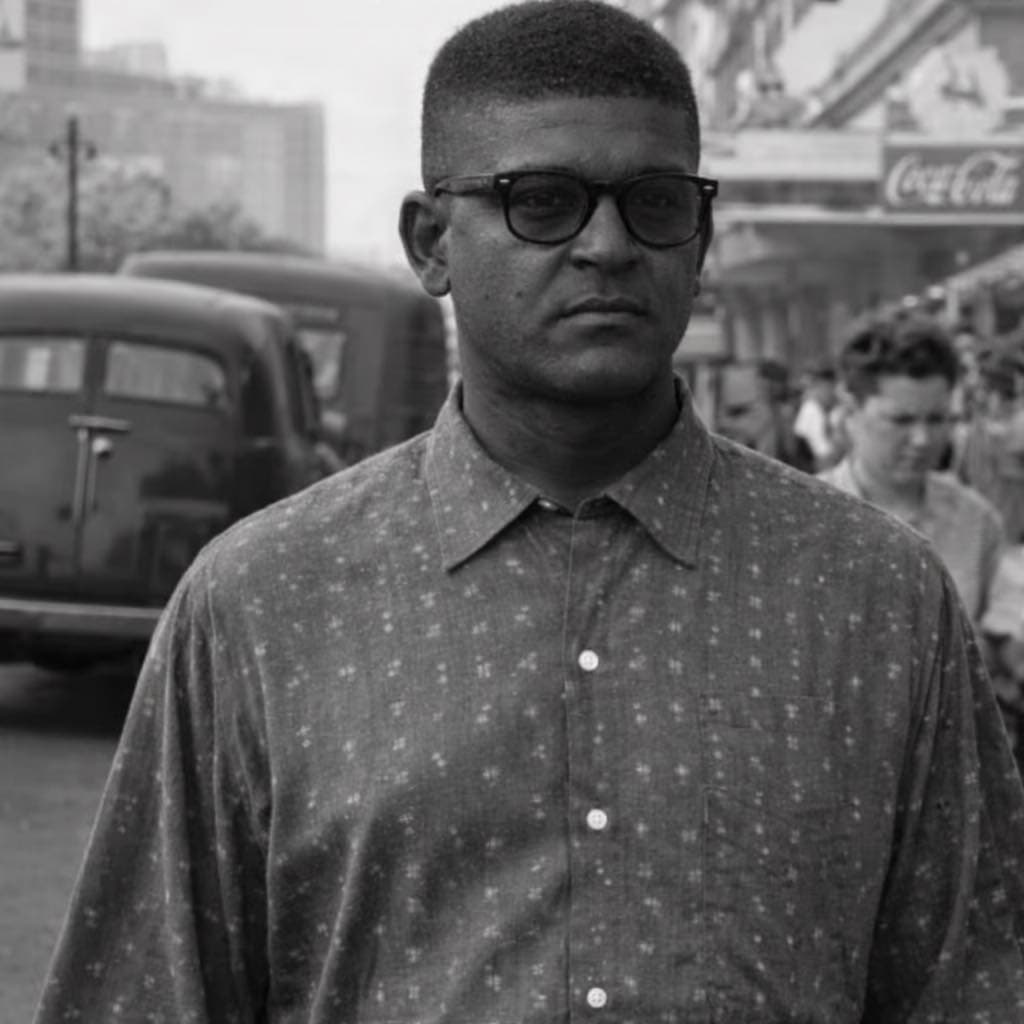
Almost immediately, his social status vanished. People who would have greeted him politely days earlier now refused eye contact. He was denied access to restrooms, restaurants, and basic dignity. Police officers treated him with suspicion. Strangers spoke to him with hostility or fear. Even simple acts—sitting on a bus, asking for directions, looking for a place to sleep—became dangerous calculations.
He documented the psychological toll of racism as much as its physical restrictions. The constant vigilance. The isolation. The way humiliation seeped into the body and mind. He wrote about how quickly the world taught him his “place,” and how exhausting it was to survive in a society designed to break you down quietly.
When his work was published, exposing the everyday realities of racism to a white American audience, the reaction was explosive. Rather than confronting the truth he revealed, many responded with rage. He received hate mail and death threats. His effigy was hung in his hometown. Friends turned away. For telling the truth, he became a target.
The threats grew so serious that he was forced to leave the United States. He moved to Mexico, where he lived in exile for several years—not because he had committed a crime, but because he had revealed one. His experiment had stripped away comforting myths and exposed the cruelty embedded in everyday American life.
His story remains a reminder that racism is not just about laws or signs—it is about power, fear, and the daily erosion of humanity. And it also reminds us how dangerous it can be to tell the truth in a society that benefits from silence.