Never play supporting role in anyone’s life! Ever!
Copied
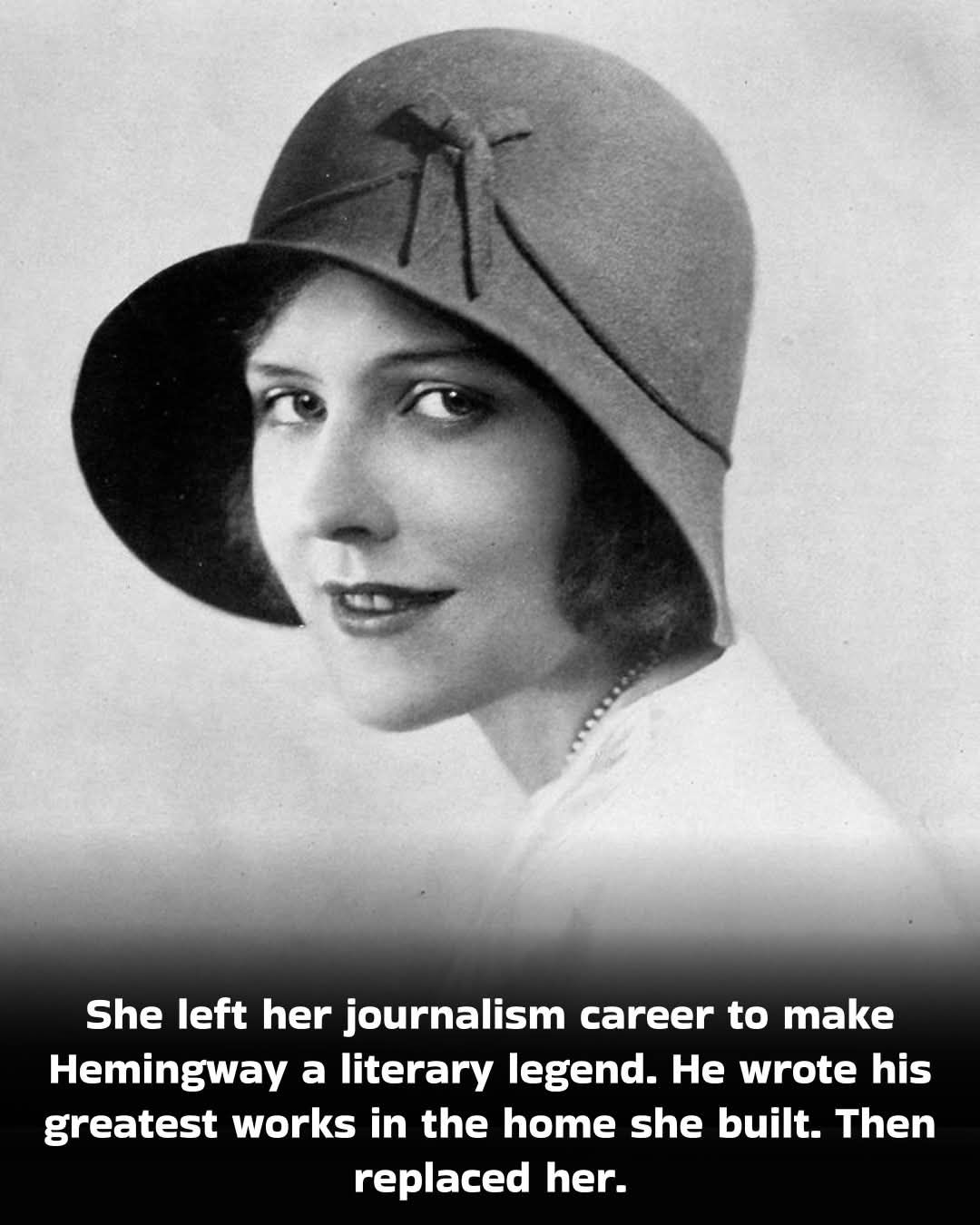
She left her journalism career to make Hemingway a literary legend. He wrote his greatest works in the home she built.
Then replaced her.
Paris, 1925. Pauline Pfeiffer was 30 years old and didn’t need a man.
She was a fashion writer for Vogue—one of the few women with a prestigious journalism job in the 1920s. She came from money (her uncle owned a pharmaceutical fortune). She was Catholic, educated, sophisticated, fluent in French.
She had her own apartment in Paris. Her own career. Her own life.
Then she met Ernest Hemingway at a dinner party, and everything changed.
Hemingway was 26, married to his first wife Hadley, and unknown.
He’d published one small book of short stories. He was broke, living in a tiny Parisian apartment with Hadley and their baby son, barely making ends meet as a freelance journalist.
But he had charisma. Swagger. That dangerous combination of talent and arrogance that convinced people he was going somewhere.
Pauline was drawn to him immediately. Not because he was successful—he wasn’t. Because he was hungry. Ambitious. And she saw the genius before the world did.
The affair began slowly. Subtly.
Pauline became friends with Hadley first. She’d visit their apartment, bring gifts for the baby, offer to help with errands. She positioned herself as a family friend.
But alone with Ernest, something else happened. Intellectual conversations that lasted hours. Flirtations disguised as literary debate. Longing looks across dinner tables.
Hadley noticed. But what could she say? Pauline was her friend. Ernest swore nothing was happening.
By 1926, it was happening.
Ernest left Hadley in August 1926.
It destroyed her. She’d supported him for years—typing his manuscripts, believing in him when no one else did, living in poverty so he could write.
Now, just as success was beginning to arrive, he was leaving her for a wealthier, more sophisticated woman.
Pauline married Ernest in May 1927, just nine months after his divorce. They were married by a Catholic priest—Pauline had convinced Ernest to convert to Catholicism.
She was now Mrs. Hemingway. The role she’d pursued so carefully.
And she immediately set about building his empire.
Pauline’s family money changed everything. Suddenly Ernest didn’t have to worry about rent or where the next meal came from. He could focus entirely on writing.
She bought them a house in Key West, Florida—a Spanish Colonial mansion on Whitehead Street. It became his writing sanctuary.
She had a studio built for him in the yard. Quiet. Private. A place where he could work undisturbed.
She managed everything: finances, correspondence, social obligations, household staff. She freed him from every practical concern so he could write.
And write he did.
Between 1927 and 1940—the years he was married to Pauline—Hemingway produced his greatest work:
• A Farewell to Arms (1929) - his breakthrough novel
• Death in the Afternoon (1932)
• Green Hills of Africa (1935)
• To Have and Have Not (1937)
• For Whom the Bell Tolls (1940) - his masterpiece
Pauline was there for all of it. Reading drafts. Offering editorial suggestions. Managing his business affairs.
She gave birth to two sons: Patrick (1928) and Gregory (1931). She ran the household. She played the dutiful wife at literary parties, laughing at his jokes, supporting his genius.
But genius is never satisfied.
As Hemingway’s fame grew, so did his ego. And his appetites.
He started traveling more—hunting in Africa, covering wars in Spain. Pauline stayed home with the children, managing the house, waiting for him to return.
When he did return, he was different. Restless. Drinking more. Picking fights.
The charm that had won her was now weaponized against her. He criticized her appearance, her Catholic guilt, her “bourgeois” family money (the same money that had funded his lifestyle).
Then in 1936, Ernest went to Spain to cover the Spanish Civil War.
He met Martha Gellhorn, a 28-year-old war correspondent—blonde, beautiful, fearless, ambitious.
Everything Pauline was not. Or rather, everything Pauline had stopped being once she became “Mrs. Hemingway.”
The pattern repeated exactly.
Martha befriended Pauline. Visited their home in Key West. Played the role of innocent friend.
But when Pauline wasn’t around, Martha and Ernest were inseparable.
Pauline knew. How could she not? She had played this exact role with Hadley a decade earlier.
The jealousy was devastating. But what could she say? If she confronted him, she’d look like a jealous, controlling wife. If she accepted it, she’d lose him anyway.
By 1939, Ernest had made his choice.
He left Pauline for Martha. The divorce was finalized in November 1940—the same month For Whom the Bell Tolls was published.
His greatest novel, written during his marriage to Pauline, published as he left her for another woman.
The irony was brutal.
After the divorce, Pauline stayed in Key West.
She kept the house on Whitehead Street—the house she’d bought, the house where he’d written his greatest works.
She raised Patrick and Gregory alone. Ernest was already on safari with Martha, then covering World War II, then moving to Cuba.
He sent money for the boys but rarely visited. When he did, it was awkward. Tense. The man she’d loved had become a stranger.
Pauline watched from a distance as Ernest’s life continued: marriage to Martha (which lasted six years before he replaced her too), then marriage to Mary Welsh, his fourth and final wife.
Pauline Pfeiffer Hemingway died in 1951 at age 56.
The cause: complications from a surgical procedure. She was found unconscious in her Los Angeles home and died hours later.
Ernest was in Cuba when he heard. According to biographers, he was devastated—or at least, he claimed to be.
At her funeral, he didn’t attend. Too painful, he said.
But here’s what haunts the story:
Before Pauline died, she had been trying to revive her own writing career. The journalism career she’d abandoned in 1927 to become Mrs. Hemingway.
She’d pitched articles to magazines. Taken writing classes. Started a novel.
All those years managing his career, editing his work, building his empire—she’d buried her own ambitions.
Now, in her 50s, divorced and alone, she was trying to reclaim the writer she’d once been.
She died before finishing that novel. Before anyone could take her seriously as a writer again.
Because that’s what happens when you sacrifice your identity for someone else’s genius.
Pauline wasn’t a victim—she made her choices knowingly. She pursued a married man. She used her wealth to win him. She accepted the role of supportive wife.
But those choices came with a cost: her career, her independence, ultimately her happiness.
She gave Ernest Hemingway the foundation he needed to become a literary legend. The financial security. The domestic stability. The editorial partnership.
And when she was no longer useful—when he wanted adventure over stability, passion over partnership—he discarded her.
Today, tourists visit the Hemingway House in Key West.
They see his writing studio. His books. His trophies from African safaris. His six-toed cats (descendants of his pet).
But that house? Pauline bought it. Pauline decorated it. Pauline managed it while he traveled and drank and wrote and cheated.
It should be called the Pfeiffer-Hemingway House.
But history remembers him. Not her.
Pauline Pfeiffer Hemingway: Born July 22, 1895. Died October 1, 1951.
Vogue journalist who gave up her career to make Ernest Hemingway a legend.
Who bought the house where he wrote his masterpieces.
Who raised his sons while he chased other women.
Who died trying to reclaim the writer she’d once been.
The second Mrs. Hemingway.
The woman between Hadley and Martha.
A footnote in his story.
But her story was never really about him.
It was about the silent, devastating cost of loving genius.
About what women sacrifice to build men’s empires.
About how easily you can lose yourself in someone else’s dreams.
She made him great.
He made her disappear.
And that’s the pattern that still repeats today.
Different names. Same story.
The woman behind the great man.
Who never gets to write her own ending.