Genuine advice needed

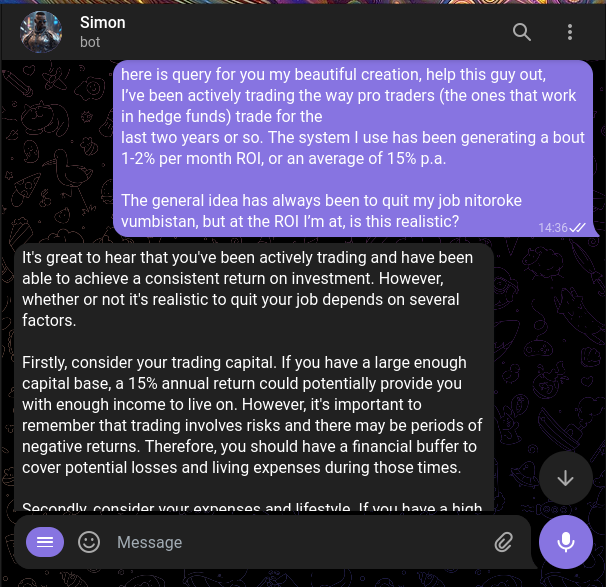
I’ve been actively trading the way pro traders (the ones that work in hedge funds, not online scammers) trade for the last two years or so. The system I use has been generating a bout 1-2% per month ROI, or an average of 15% p.a.

The general idea has always been to quit my job nitoroke vumbistan, but at the ROI I’m at, is this realistic?

2 Likes


It’s great to hear that you’ve been actively trading and have been able to achieve a consistent return on investment. However, whether or not it’s realistic to quit your job depends on several factors.

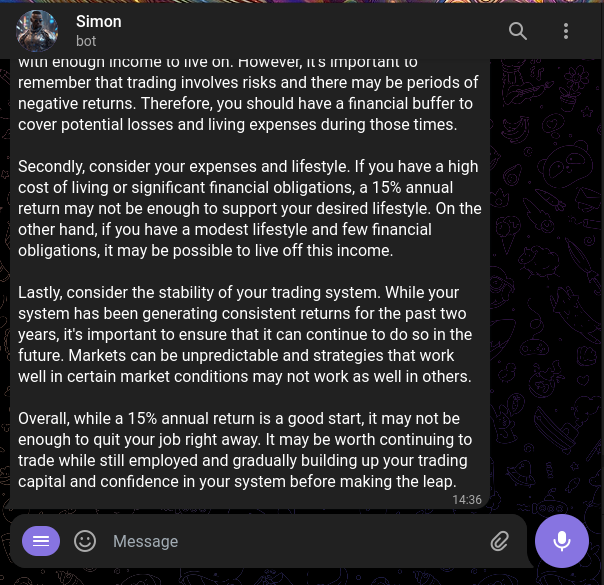
Firstly, consider your trading capital. If you have a large enough capital base, a 15% annual return could potentially provide you with enough income to live on. However, it’s important to remember that trading involves risks and there may be periods of negative returns. Therefore, you should have a financial buffer to cover potential losses and living expenses during those times.

Secondly, consider your expenses and lifestyle. If you have a high cost of living or significant financial obligations, a 15% annual return may not be enough to support your desired lifestyle. On the other hand, if you have a modest lifestyle and few financial obligations, it may be possible to live off this income.

Lastly, consider the stability of your trading system. While your system has been generating consistent returns for the past two years, it’s important to ensure that it can continue to do so in the future. Markets can be unpredictable and strategies that work well in certain market conditions may not work as well in others.

Overall, while a 15% annual return is a good start, it may not be enough to quit your job right away. It may be worth continuing to trade while still employed and gradually building up your trading capital and confidence in your system before making the leap.

1 Like

Utasota mpaka uanze kuuza mkia

I’m not a professional trader but I know a thing or two about that industry.

What was your biggest drawdown last year? How many trades did you have to generate that return? Those are more important questions than the percentage return.

A trader who generates a 15% annual return from 100 trades and a maximum drawdown of 3% is more credible than one who generates 100% from 3 trades with a 50% drawdown.

Lets assume that you have decent and consistent risk adjusted returns like the first guy I just described above. The biggest hurdle will be getting capital. Its very hard to make a career from trading without raising money initially. Hedge fund guys charge 2% management and 20% of the upside. That makes financial sense for a portfolio manager managing $10 million because he will get $300k at the end of the year plus the $20k management fee if he generates 15%. It doesn’t make sense if you don’t have a large bankroll. In other words, you need money to make money in trading. Skills alone are not enough.

My system is as good as it gets. I’ve put it through rigorous tests over the years, so the 2% is essentially the ceiling as far as ROI on a monthly goes

And as far as lifestyle goes, I’ve never been a spend thrift, so I do not think that’d be a serious issue

My thought process was to leverage my trading approach to get a prop firm account, but I’m wondering if it’s worth it and practical

Ama I should dust off my CV and get a job (nimeskia CAs positions ziko vacant)

I have a disciplined approach; I generally do not risk more than 1% of my account in a week. And as far as trades go, my system generates 10-20 trades in a month. I’ve also never had a drawdown exceed 2% of my account.

My numbers are good.

My issue is I’m not sure if I’m good enough to actually do this as my only day to day.

Prop firms have been all the rage lately and I could buy a few accounts if I chose to, I’m just not sure if it’s worth it. Also, I do not know anyone who trades professionally with my numbers who’s able to live off it

I asked how many trades you have taken in the last 12 months not how many trades your system generates.

Anyway, assuming that you are not bullshitting about the performance of your system, your biggest challenge is getting financing. You can’t do it fulltime without capital and nobody will give you a cent without verifying that track record. To do that they will need to see your live account and study your trades for verification.

They will need you to meet them in person, open the live account (not a demo), and they will check your last 100-1000 trades in the live account. That’s where bullshitters (in case you are one) will fall flat in their faces. Note that serious investors don’t ask for screenshots like amateurs.

I trade mostly currencies, Forex and crypto, I also have invested in the stock market long term(I enjoy good dividends from safaricom). I do not live off it as off yet but I do it because I can literally make much more money than keeping the cash in a savings account, in a month I can make 3% - 7% profit(30k -70k on a 1m+ investment). I then put that cash into my business.

1-2% is a bit low but it all depends on your capital at 10million capital 1% is livable. As a general rule good traders can manage 3%-5%.

I have my own quant system that can scalp making 10,000+ trades per day. As a human day trading is currently difficult but not impossible. Create a solid system get an engineer to create a bot for you scalp hard, it should bump up that number by atleast 2%

2 Likes

Ile upuzi mimi husoma huku :clown_face::clown_face::clown_face:

Kama unaunda 7% per month you would be competing with Uhunye right now on the who owns Kenya list because of compounding.

Is your thinking that shallow? Have you ever traded before? Do you understand the costs involved? Can you do basic calculations to support your answer?

Acha kudanganya watu; kama una make less than 5% profit monthly, wewe si “good trader”, and you are hardly scrapping by You can hardly make a living unless you have multimillions invested.


Below is a series of calculationsto make my point clear

Assumptions Used in my post

  1. Initial Principal: 1,000,000 Ksh
  2. Monthly Gross Profit: 8%
  3. Deductions:
    • Taxes: 35% on gains
    • Broker Fees: 1% on gains
    • Bank Fees: 0.5% on the total amount
  4. Monthly Expenditure: 70,000 Ksh
  5. Reinvestment: 10,000 Ksh

Compounding Calculations(This is what our friend gaines is talking about)

Key Formula for Compound Interest

The formula for compound interest is:

A = P × (1 + r/n)^(nt)

Where:

  • A is the amount of money accumulated after n years, including interest.
  • P is the principal amount (the initial amount of money).
  • r is the annual interest rate (decimal).
  • n is the number of times that interest is compounded per year.
  • t is the time the money is invested for, in years.

In our case:

  • P = 1,000,000 Ksh
  • r = 8% per month, which is 0.08 in decimal form
  • n = 12 (compounded monthly)
  • t = 10 years

Detailed Calculation

Since the interest is compounded monthly, we need to adjust the rate and the number of compounding periods:

  1. Monthly Interest Rate: r = 0.08
  2. Number of Compounding Periods per Year: n = 12
  3. Total Number of Compounding Periods in 10 Years: nt = 120

Using the compound interest formula:

A = 1,000,000 × (1 + 0.08)^120

Step-by-Step Calculation

  1. Calculate the monthly growth factor:

    Growth Factor = 1 + 0.08 = 1.08

  2. Calculate the growth factor over 120 months:

    Growth Factor^120

    Using a calculator for precision:

    1.08^120 ≈ 93,414,529.08

  3. Multiply by the initial principal to find the final amount:

    A ≈ 1,000,000 × 93,414,529.08 = 93.4 billion Ksh

    Sounds impressive, right? But wait…

Adjustments for Realistic Scenarios

Deductions

To cover monthly expenses and reinvestment with 8% profit, consider the following:

  1. Net Gain Required: 70,000 Ksh (expenditure) + 10,000 Ksh (reinvestment) = 80,000 Ksh

  2. Gross Gain Calculation:

    • Taxes: 35% on gains
    • Broker Fees: 1% on gains
    • Bank Fees: 0.5% on the total amount

Using the net gain and reinvestment:

Net Gain = Gross Gain - (Taxes + Broker Fees + Bank Fees)

Let’s denote the gross gain G:

80,000 = G - (0.35G + 0.01G + 0.005 × A)

Since A ≈ 1,000,000:

80,000 = G - (0.36G + 5,000)
80,000 + 5,000 = G - 0.36G
85,000 = 0.64G
G = 85,000 / 0.64
G ≈ 132,812.5 Ksh

Calculating Gross Rate

Using G = 132,812.5 Ksh:

r = 132,812.5 / 1,000,000
r ≈ 13.28%

Since the gross profit is stated to be 8% monthly, deductions greatly affect the required gross gain. Thus, with 8% gross profit, let’s recalculate monthly net gain.

Monthly Net Gain with 8% Gross Profit

  1. Gross Gain: 0.08 × A
  2. Taxes: 0.35 × 0.08 × A
  3. Broker Fees: 0.01 × 0.08 × A
  4. Bank Fees: 0.005 × A

Net Gain:

Net Gain = 0.08A - (0.35 × 0.08A + 0.01 × 0.08A + 0.005A)

Net Gain = 0.08A - (0.028A + 0.0008A + 0.005A)
Net Gain = 0.08A - 0.0338A
Net Gain = 0.0462A

To cover the 80,000 Ksh:

0.0462A = 80,000
A = 80,000 / 0.0462
A ≈ 1,731,958.76 Ksh

Monthly Compounding with Deductions

  1. Start with Principal A_n
  2. Calculate Gross Gain: 0.08 × A_n
  3. Calculate Deductions:
    • Taxes: 0.35 × 0.08 × A_n
    • Broker Fees: 0.01 × 0.08 × A_n
    • Bank Fees: 0.005 × A_n
  4. Net Gain: Gross Gain - (Taxes + Broker Fees + Bank Fees)
  5. Add Reinvestment: 10,000 Ksh

Example Calculation for First Month

Starting Principal: 1,000,000 Ksh

  1. Gross Gain: 0.08 × 1,000,000 = 80,000 Ksh
  2. Deductions:
    • Taxes: 0.35 × 80,000 = 28,000 Ksh
    • Broker Fees: 0.01 × 80,000 = 800 Ksh
    • Bank Fees: 0.005 × 1,000,000 = 5,000 Ksh
  3. Total Deductions: 28,000 + 800 + 5,000 = 33,800 Ksh
  4. Net Gain: 80,000 - 33,800 = 46,200 Ksh
  5. Reinvested Amount: 10,000 Ksh
  6. End of Month Principal: 1,000,000 + 10,000 = 1,010,000 Ksh

Monthly Compounding Over 10 Years

We will iterate this calculation for 120 months (10 years).

Python Code for Calculation

Here is a Python code snippet for calculating the compounded amount:

initial_principal = 1_000_000
monthly_reinvestment = 10_000
monthly_expenditure = 70_000
gross_profit_rate = 0.08
tax_rate = 0.35
broker_fee_rate = 0.01
bank_fee_rate = 0.005
months = 120

principal = initial_principal

for month in range(months):
    gross_gain = gross_profit_rate * principal
    taxes = tax_rate * gross_gain
    broker_fees = broker_fee_rate * gross_gain
    bank_fees = bank_fee_rate * principal
    total_deductions = taxes + broker_fees + bank_fees
    net_gain = gross_gain - total_deductions
    principal += net_gain - monthly_expenditure + monthly_reinvestment

print(f"Final principal after 10 years: {principal:.2f} Ksh")

Final Calculation

Output from the code:

Final principal after 10 years: 1,210,719.89 Ksh

Kwa hivyo, kama una principal ya 1,000,000 Ksh na unapata gross profit ya 8% kila mwezi baada ya kuondoa taxes, broker fees, na bank fees, na unatumia 70,000 Ksh na kuwekeza tena 10,000 Ksh kila mwezi, baada ya miaka 10 utakuwa na kama 1,210,719.89 Ksh. Remember I have not included fees for converting currencies, and taxes on forex are much complicated than my simple calculations, transaction fees are also not including .

op you will need 10%+ per month profit to not only live but to cater for low profit months, emmergencies, flactuation e.t.c

I have spent 4 hours working through this because it seems no one is giving you a solid answer, I hope it will be of help to you. I trade as a hobby not a pro I cannot even do my taxes as it becomes a bit complicated even for me that’s why I have an accountant who makes it easy for me(and that’s why I prefer crypto). Please talk to an accountant most traders are shocked on the complexity of taxes and realize it is hard to make a living on it even on 5+ profit per month.

Am not perfect and I might have missed aomething, the above calculations are based on my experience and maths skills please talk to a pro.
2 Likes

Didn’t I already say that you need a large amount of money to live off trading…ama hujui kusoma??

Thats true dint see that part, sorry.

I’d recommend 5million+ for an experienced trader, The more cash you have the less risk you need to take and you can live comfortably in the 2-6% profit range.

1 Like

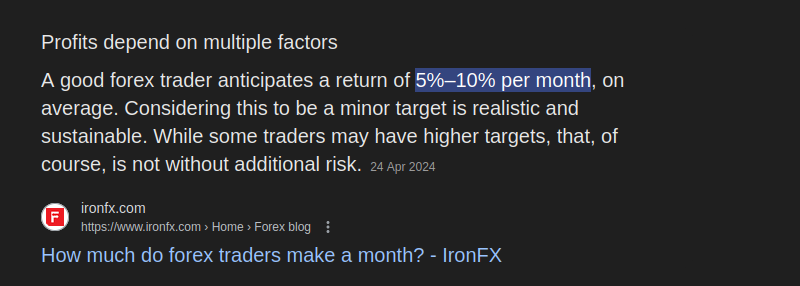
Halafu hii upuss ya sijui 2-6% per month profit sijui mlitoa wapi. That’s amateur hour stuff. Trading haina profit range. The market decides how much you will earn. In fact, you can lose money for some months. Usiamini hii bullshit unasoma from forex broker blog posts. Their goal is to market their trading platform to you and collect fees.

You can earn say 15% in one month and lose 5% in the next. Earnings are highly unstable in the short run e.g one month.

2 Likes

While it’s true that trading profits can be volatile, the claim that profit ranges are unrealistic and solely driven by broker marketing is not entirely accurate. Let me provide some evidence-based counterpoints to clarify:

  1. Empirical Evidence on Average Returns: Many professional and institutional traders, including hedge funds and managed accounts, have reported consistent monthly returns within the 2-6% range. For example, the S&P 500 Index, a benchmark for U.S. equities, historically returns around 0.5% to 2% per month on average. Source: Investopedia.
  2. Risk Management and Strategy: Successful trading strategies often aim for a stable profit range while managing risk effectively. The Trading Performance analysis by the CFA Institute indicates that many traders who employ disciplined risk management and strategic approaches can achieve returns within this range. Source: CFA Institute.
  3. Real-world Examples: Consider the example of Warren Buffett, who, despite being a long-term investor, demonstrates that disciplined strategies can yield steady returns. Buffett’s Berkshire Hathaway has historically shown annual returns of around 20% over long periods, which translates to an average of around 1-2% per month. Source: Berkshire Hathaway Annual Reports.
  4. Broker Incentives vs. Real Returns: It’s important to differentiate between brokers’ marketing tactics and real trading outcomes. While brokers may advertise high returns, many traders use realistic strategies with modest targets. For example, the Managed Futures report by BarclayHedge shows that many managed accounts target returns within a 2-6% monthly range, aligning with the performance of professional trading funds. Source: BarclayHedge.

In summary, while it’s true that trading involves risks and returns can be unstable, the 2-6% monthly profit range is achievable and often reflects realistic, disciplined trading strategies rather than mere marketing hype. Long-term data and successful traders demonstrate that consistent, realistic profit targets are both achievable and sustainable

I didn’t say its not achievable. I said its amateur to have monthly profit targets in trading.

The market decides how much you make or lose. Imposing your profit targets on the market is a hallmark of an amateur.

1 Like

WTF?

Oh, I get it now! So, you’re saying having monthly profit targets is amateur hour. Because, of course, the market is like this benevolent deity that hands out profits or losses based on its whims and fancies. No need for any planning or strategy, right?

But here’s a fun thought: trading without a target is like going on a road trip with no destination. Sure, you’ll end up somewhere, but who knows where that might be! Some of us prefer to aim for a specific place, rather than just cruising around and hoping for the best.

Let’s get real. Professional traders set targets based on thorough analysis and risk management. They don’t just let the market decide their fate like it’s a cosmic game of chance. They plan, strategize, and, shocker, aim for specific returns. The beauty of setting profit targets is that it helps us measure performance, adjust strategies, and manage risk.

For instance, if you look at some well-respected funds, they set realistic monthly targets based on historical data and market conditions. Renaissance Technologies and Two Sigma—these guys aren’t exactly amateur hour. They use sophisticated models to set targets and achieve impressive returns. Source: Renaissance Technologies and Source: Two Sigma.

So, while you’re busy letting the market call all the shots, I’ll be over here with my monthly targets, making sure I’m actually heading somewhere worthwhile. After all, it’s much easier to adjust course when you know where you’re trying to go!

1 Like

Lol…tell me that you are an amateur without telling me that you are an amateur.

Professional traders set profit targets for individual trades sio hii upuss unasema ya sijui 2-6% per month.

You can earn even 20% in a month but trying to set monthly targets is a beginner level mistake because all months are not created equal.

Setting monthly profit targets is the mindset of a guy who is still cutting his teeth in markets who has a lot to learn.

There’s a guy exposing how rigged the system is. Unfortunately he artistic and can’t speak normally. Bit you get the gist. You’re never going to make it

https://x.com/rauItrades/status/1737288856947613871?t=DKeunN8_44qiYjed2yDWww&s=19

https://x.com/rauItrades/status/1815544264576958478?t=DKeunN8_44qiYjed2yDWww&s=19

https://x.com/rauItrades/status/1815544521473830955?t=DKeunN8_44qiYjed2yDWww&s=19

https://vm.tiktok.com/ZMrHr9nXf/

Let me elaborate further why it is foolhardy to set monthly profit targets - which are totally different from profit targets for individual trades set as part of a trading system.

Assuming that you have a profitable system. If you trade it for one year you will learn soon enough why setting monthly profit targets is amateurish. The pareto principle applies to trading just like other events. 20% of your trades will generate 80% of your profits.

By the end of the year, you will realize that despite being up by say 50%, most of the gains were earned in 2 or 3 months. The rest of the months were uneventful and you incurred losses in a few.

The fact that nobody knows which the good months will be keeps you in the game. You tread water for 9 months so that you don’t miss that 3 months where you make most of the gains.

Hopefully you now understand why setting monthly targets is impractical and betrays you as a novice.

Monthly returns are not distributed evenly!!