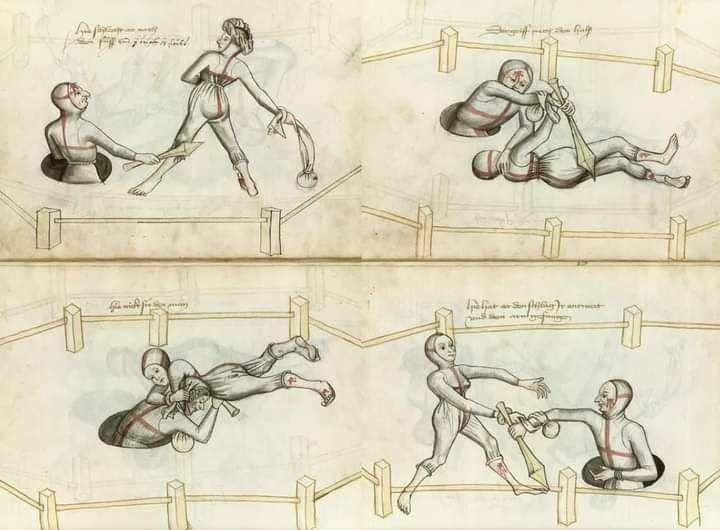
In medieval Europe, getting a divorce was about as easy as finding a dragon at a pet store, so couples tired of each other sometimes opted for the dramatic solution: a divorce duel. Hans Talhofer, a German combat instructor and court adviser, penned the Fechtbuch (“Fencing Book”) in 1467, a manual that included handy tips for couples ready to duke it out.
To level the playing field, since men generally had the brawn advantage, the rules were creatively quirky. Husbands, armed with three clubs, had to fight from inside a waist-high hole about three feet wide, with one hand tied to their body. Meanwhile, wives, armed with three hefty rocks weighing up to eight pounds each (imagine a medieval sock full of batteries), could dance around the hole like it was their personal battlefield.
Both sides had to wield weapons of equal length, because fairness is key when you’re trying to clobber your spouse. If a husband touched the hole’s edge, he’d lose a club. Do it three times, and he’d be left trying to win an unarmed round of medieval Whac-A-Mole, likely hoping to wrestle his wife into the hole before she could turn his head into a pancake.
Talhofer’s manual didn’t just stop at weapons; it also gave fashion tips and step-by-step moves to outsmart the soon-to-be ex. Despite the chaos, these duels were surprisingly fair, with many women claiming victory. The catch? Winning wasn’t exactly a ticket to freedom. If the wife won, her hubby was executed. If the husband won, she got the delightful fate of being buried alive.