Due to the current state of the country, I had some free time today, a little hobby I do is cracking hidden codes and encryption today I worked on the kryptos code. This is a small article going into detail I assume you have no prior knowledge whatsoever in code breaking I will explain even the most basic conceptd, enjoy!
Unraveling the Mystery of the Kryptos Code 

Hey there, Have you ever heard of the Kryptos code?  It’s this super mysterious sculpture at the CIA headquarters in Langley, Virginia, that’s been baffling minds since it was unveiled in 1990. Buckle up as we take a fun yet technical ride through its history, the code itself, and how to crack it! first let me put the picture for you guys
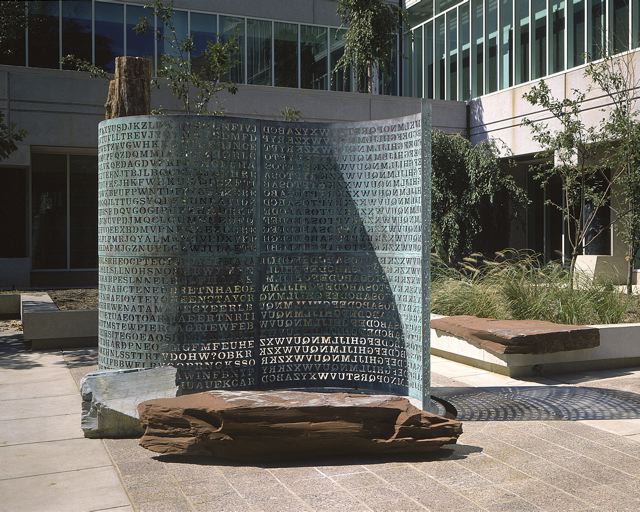
The History of Kryptos 
So, Kryptos is this cool sculpture see above created by artist Jim Sanborn. The name “Kryptos” comes from the Greek word for “hidden,” and boy, does it live up to its name! Sanborn embedded four encrypted messages in the sculpture, and even the CIA and NSA has struggled with it. Three out of four parts have been cracked, but the final section, known as “K4,” remains unsolved. Intrigued yet? Let’s dive into the details!
The Full Code 
Kryptos consists of four sections of code, each adding to the mystery. Here they are:
K1:
EMUFPHZLRFAXYUSDJKZLDKRNSHGNFIVJYQTQUXQBQVYUVLLTREVJYQTQUXQHGQYRVKNHNPKYREOGHPWH
K2:
RGDTAHLDQWIYTWRAHUOGVWGQSSGGQWFSVGDDRGGWHFYUMFUJMGQSUGIHWMFUQKZRNGKXRVDYKOLEANKK
K3:
ENDYAHROHNLSRHEOCPTEOIBIDYSHNAIAACHURNQLIRDLXXYNQFYRMUFPEDRXRIIVNDUXLEVKQYLBKQDC
K4:
OBKR
UOXOGHULBSOLIFBBWFLRVQQPRNGKSSO
How to Crack It
Cracking Kryptos is like solving a jigsaw puzzle with pieces scattered all over. Here’s a step-by-step guide on how parts of it have been deciphered so far:
First we need to understand the Vigenère cipher and the Vigenère square, we will use this to crack k1 and k2. 
The Vigenère Square
The Vigenère square is a 26x26 grid filled with the alphabet, but each row is shifted one position to the left from the row above it. Here’s how it looks:
   A B C D E F G H I J K L M N O P Q R S T U V W X Y Z
A  A B C D E F G H I J K L M N O P Q R S T U V W X Y Z
B  B C D E F G H I J K L M N O P Q R S T U V W X Y Z A
C  C D E F G H I J K L M N O P Q R S T U V W X Y Z A B
D  D E F G H I J K L M N O P Q R S T U V W X Y Z A B C
E  E F G H I J K L M N O P Q R S T U V W X Y Z A B C D
F  F G H I J K L M N O P Q R S T U V W X Y Z A B C D E
G  G H I J K L M N O P Q R S T U V W X Y Z A B C D E F
H  H I J K L M N O P Q R S T U V W X Y Z A B C D E F G
I  I J K L M N O P Q R S T U V W X Y Z A B C D E F G H
J  J K L M N O P Q R S T U V W X Y Z A B C D E F G H I
K  K L M N O P Q R S T U V W X Y Z A B C D E F G H I J
L  L M N O P Q R S T U V W X Y Z A B C D E F G H I J K
M  M N O P Q R S T U V W X Y Z A B C D E F G H I J K L
N  N O P Q R S T U V W X Y Z A B C D E F G H I J K L M
O  O P Q R S T U V W X Y Z A B C D E F G H I J K L M N
P  P Q R S T U V W X Y Z A B C D E F G H I J K L M N O
Q  Q R S T U V W X Y Z A B C D E F G H I J K L M N O P
R  R S T U V W X Y Z A B C D E F G H I J K L M N O P Q
S  S T U V W X Y Z A B C D E F G H I J K L M N O P Q R
T  T U V W X Y Z A B C D E F G H I J K L M N O P Q R S
U  U V W X Y Z A B C D E F G H I J K L M N O P Q R S T
V  V W X Y Z A B C D E F G H I J K L M N O P Q R S T U
W  W X Y Z A B C D E F G H I J K L M N O P Q R S T U V
X  X Y Z A B C D E F G H I J K L M N O P Q R S T U V W
Y  Y Z A B C D E F G H I J K L M N O P Q R S T U V W X
Z  Z A B C D E F G H I J K L M N O P Q R S T U V W X Y
How It Works
Encryption:
- Choose a keyword (e.g., “KEY”).
- Repeat the keyword until it matches the length of the plaintext.
- Use the Vigenère square to find the ciphertext.
Decryption:
- Use the keyword and the Vigenère square to revert the ciphertext back to the plaintext.
Example Time!
Encryption Example
Let’s encrypt the message “HELLO” with the keyword “KEY”:
- Align the keyword with the plaintext:
Plaintext:  H E L L O
Keyword:    K E Y K E
- Find each letter using the Vigenère square:
- H (plaintext) and K (keyword):
- Go to row ‘K’ (which is the 11th row starting from A, if we count A as 0).
- Find the column ‘H’.
- Intersection letter is ‘R’.
- E (plaintext) and E (keyword):
- Go to row ‘E’.
- Find the column ‘E’.
- Intersection letter is ‘I’.
- L (plaintext) and Y (keyword):
- Go to row ‘Y’.
- Find the column ‘L’.
- Intersection letter is ‘J’.
- L (plaintext) and K (keyword):
- Go to row ‘K’.
- Find the column ‘L’.
- Intersection letter is ‘V’.
- O (plaintext) and E (keyword):
- Go to row ‘E’.
- Find the column ‘O’.
- Intersection letter is ‘S’.
So, “HELLO” encrypted with “KEY” becomes “RIJVS”.
Decryption Example
Let’s decrypt “RIJVS” with the keyword “KEY”:
- Align the keyword with the ciphertext:
Ciphertext: R I J V S
Keyword:    K E Y K E
- Find each letter using the Vigenère square:
- R (ciphertext) and K (keyword):
- Go to row ‘K’.
- Find where ‘R’ is in that row.
- Column heading is ‘H’.
- I (ciphertext) and E (keyword):
- Go to row ‘E’.
- Find where ‘I’ is in that row.
- Column heading is ‘E’.
- J (ciphertext) and Y (keyword):
- Go to row ‘Y’.
- Find where ‘J’ is in that row.
- Column heading is ‘L’.
- V (ciphertext) and K (keyword):
- Go to row ‘K’.
- Find where ‘V’ is in that row.
- Column heading is ‘L’.
- S (ciphertext) and E (keyword):
- Go to row ‘E’.
- Find where ‘S’ is in that row.
- Column heading is ‘O’.
So, “RIJVS” decrypted with “KEY” becomes “HELLO”.
Wrapping It Up
The Vigenère cipher is a classic, yet powerful encryption method, and the Vigenère square makes it straightforward to use. Armed with this knowledge, you can now encrypt and decrypt messages like a pro. so tuendelee with our journey


Step 1: Understanding the Method 
The first three parts (K1, K2, and K3) were cracked using a Vigenère cipher. This is a method of encrypting alphabetic text by using a simple form of polyalphabetic substitution as shown above. Here’s how it works:
- Choose a Keyword: The keyword acts as the cipher key. For Kryptos, “PALIMPSEST” and “ABSCISSA” were used for K1 and K2.
- Encrypting: Each letter in the plaintext is shifted along some number of places defined by the keyword.
Step 2: Cracking K1 
For K1, the keyword “PALIMPSEST” was used. Here’s how the first part was decrypted:
- Align the Keyword: Write the keyword above or below the ciphertext, repeating it until you cover the entire message.
- Decrypting: Use the Vigenère square to find the plaintext.
Example:
Ciphertext:  EMUFPHZLRFAXYUSDJKZLDKRNSHGNFIVJYQTQUXQBQVYUVLLTREVJYQTQUXQHGQYRVKNHNPKYREOGHPWH
Keyword:     PALIMPSESTPALIMPSESTPALIMPSESTPALIMPSESTPALIMPSESTPALIMPSESTPALIMPSESTPALIMPSEST
Plaintext:   BETWEEN SUBTLE SHADING AND THE ABSENCE OF LIGHT LIES THE NUANCE OF IQLUSION
Boom! The decrypted message for K1 reads: “BETWEEN SUBTLE SHADING AND THE ABSENCE OF LIGHT LIES THE NUANCE OF IQLUSION.”
Step 3: Cracking K2
For K2, the keyword “ABSCISSA” was used. Follow the same method as K1:
Example:
Ciphertext:  RGDTAHLDQWIYTWRAHUOGVWGQSSGGQWFSVGDDRGGWHFYUMFUJMGQSUGIHWMFUQKZRNGKXRVDYKOLEANKK
Keyword:     ABSCISSAABSCISSAABSCISSAABSCISSAABSCISSAABSCISSAABSCISSAABSCISSAABSCISSAABSCISSA
Plaintext:   IT WAS TOTALLY INVISIBLE HOWS THAT POSSIBLE THEY USED THE EARTHS MAGNETIC FIELD X
Wow! The decrypted message for K2 says: “IT WAS TOTALLY INVISIBLE HOWS THAT POSSIBLE THEY USED THE EARTHS MAGNETIC FIELD X.”
to crack k3 you will need to understand transposition ciphers! below is a mini guide
The Transposition Cipher
A transposition cipher rearranges the letters of the plaintext in a specific way to produce the ciphertext. Unlike substitution ciphers, it doesn’t change the actual letters but just their positions.
How It Works
- Choose a Key: The key determines how the characters in the plaintext are rearranged. It can be a word or a sequence of numbers.
- Create a Grid: Write the plaintext into a grid based on the key length.
- Read Columns: Read the characters column-wise to get the ciphertext.
Example Time!
Let’s encrypt and decrypt a message using a simple columnar transposition cipher.
Encryption Example
Let’s encrypt the message “WE ARE DISCOVERED RUN” with the keyword “ZEBRAS”:
- Choose a Key: The keyword is “ZEBRAS”. Assign numbers to each letter based on their alphabetical order:
Z E B R A S
6 2 1 4 3 5
- Create a Grid: Write the plaintext into rows under the keyword, padding with extra characters (like ‘X’) if necessary to fill the grid.
   Z  E  B  R  A  S
   6  2  1  4  3  5
W  E  A  R  E  D
I  S  C  O  V  E
R  E  D  R  U  N
X  X  X  X  X  X
- Read Columns: Read the columns in the order of the numbers assigned to the keyword:
1: A C D R X
2: E S E X X
3: D C V X X
4: E O R X X
5: D E N X X
6: W I R X X
- Ciphertext: Combine the columns to get the ciphertext:
ACDRX ESEXX DCVXX EORXX DENXX WIRXXSo, “WE ARE DISCOVERED RUN” encrypted with “ZEBRAS” becomes “ACDRXESEXXDCVXXEORXXDENXXWIRXX”.
Decryption Example
Let’s decrypt “ACDRXESEXXDCVXXEORXXDENXXWIRXX” with the keyword “ZEBRAS”:
- Choose a Key: The keyword is “ZEBRAS”. Assign numbers to each letter based on their alphabetical order:
Z E B R A S
6 2 1 4 3 5
- Determine Grid Dimensions: Calculate the number of rows needed. For a 24-character message and a 6-letter keyword, we need 4 rows.
   Z  E  B  R  A  S
   6  2  1  4  3  5
- Fill the Grid: Fill the grid column-wise using the ciphertext:
   Z  E  B  R  A  S
   6  2  1  4  3  5
A  C  D  R  X
E  S  E  X  X
D  C  V  X  X
E  O  R  X  X
D  E  N  X  X
W  I  R  X  X
- Read Rows: Read the grid row-wise to get the plaintext:
W  E  A  R  E  D
I  S  C  O  V  E
R  E  D  R  U  N
X  X  X  X  X  X
- Plaintext: Combine the rows and remove the padding characters to get the plaintext:
WEAREDISCOVEREDRUNSo, “ACDRXESEXXDCVXXEORXXDENXXWIRXX” decrypted with “ZEBRAS” becomes “WE ARE DISCOVERED RUN”.
Wrapping It Up
Transposition ciphers are all about rearranging the letters of the plaintext according to a specific pattern. They’re simple yet effective, especially when combined with other types of ciphers. Now, you can encrypt and decrypt messages using this classic method.
Step 4: Cracking K3
K3 was a bit different. The keyword wasn’t needed because it was a simple transposition cipher (see above).
Example:
Ciphertext:  ENDYAHROHNLSRHEOCPTEOIBIDYSHNAIAACHURNQLIRDLXXYNQFYRMUFPEDRXRIIVNDUXLEVKQYLBKQDC
Plaintext:   SLOWLY DESPARATLY SLOWLY THE REMAINS OF PASSAGE DEBRIS THAT ENCUMBERED THE LOWER PART OF THE DOORWAY WAS REMOVED WITH TREMBLING HANDS I MADE A TINY BREACH IN THE UPPER LEFT HAND CORNER AND THEN WIDENING THE HOLE A LITTLE I INSERTED THE CANDLE AND PEERED IN THE HOT AIR ESCAPING FROM THE CHAMBER CAUSED THE FLAME TO FLICKER BUT PRESENTLY DETAILS OF THE ROOM WITHIN EMERGED FROM THE MIST X CAN YOU SEE ANYTHING Q
The decrypted message for K3 reads: “SLOWLY DESPARATLY SLOWLY THE REMAINS OF PASSAGE DEBRIS THAT ENCUMBERED THE LOWER PART OF THE DOORWAY WAS REMOVED WITH TREMBLING HANDS I MADE A TINY BREACH IN THE UPPER LEFT HAND CORNER AND THEN WIDENING THE HOLE A LITTLE I INSERTED THE CANDLE AND PEERED IN THE HOT AIR ESCAPING FROM THE CHAMBER CAUSED THE FLAME TO FLICKER BUT PRESENTLY DETAILS OF THE ROOM WITHIN EMERGED FROM THE MIST X CAN YOU SEE ANYTHING Q.”
Step 5: The Uncracked K4 
Now we hit the uncracked part. K4 is still a mystery, but here’s what we have so far:
OBKRUOXOGHULBSOLIFBBWFLRVQQPRNGKSSO
Numerous attempts have been made to solve this using various methods, including different ciphers and keys, but it remains one of the biggest unsolved puzzles.
Wrapping It Up 
Kryptos is an enigma wrapped in a riddle, and it’s still giving us a run for our money. With K1, K2, and K3 cracked, the final piece of the puzzle, K4, awaits someone clever enough to decipher it, as of now it’s beyond my skills . If you’re up for the challenge, jaribu Who knows? Maybe you’ll be the one to finally crack it! Good luck, codebreakers!