This requires a lot of explanation that I can see @shocks is avoiding. Yes weight will keep both a matatu and a formula one car on the tarmac but there is a limit on the amount of weight you can put on a vehicle to keep it on the ground when moving at high speeds say 150km/hr. The matatu and F1 engines both power the car forward but the matatu generates high drag force as it pushes through air with its big body as compared to the aerodynamically shaped F1 car.
However, the F1 car needs more weight to be able to keep it’s tires on the ground as it achieves high speeds and to enable it to corner at high speeds (a thing that matatus cannot achieve). This is achieved by creating downforce, to help push the car’s tyres onto the track and improve cornering forces. The air that passes over and under the car creates force that is able to push the car down. You can think of downforce as virtual weight. A wing can make a plane fly, but if we put it upside down, it can make a car NOT fly. By use of inverted wings cars can be forced to stick to the ground and succeed in cornering at high speeds and move faster. Here is the wing explanation in pictures
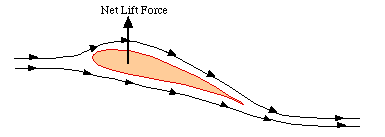
This is an aeroplane wing
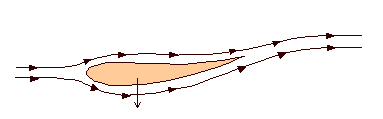
This is a F1 car wing. these are just sketches though
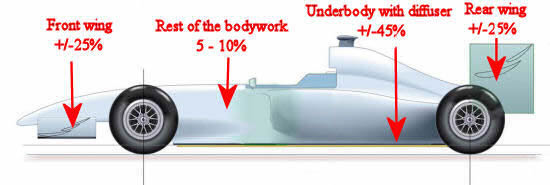
These are the parts of a formula one car that generate down force. Down force increases as the car increases speed as more air is able to push it down. It’s the opposite of what happens to a plane when it increases speed.
This is a visualization of how down force is achieved.
Here is another.
#130
